

Scientific name: Chelonia mydas
Vern: green sea turtle (En); soepschilpad (Du); tartaruga-verde (BrP); tortuga verde (Sp); tortue verte (Fr)
Local: krape (Sr)
Indig: krapé (Ka); kutarú (Lok)
Class: Reptiles
Order: Testudines
Family: Cheloniidae
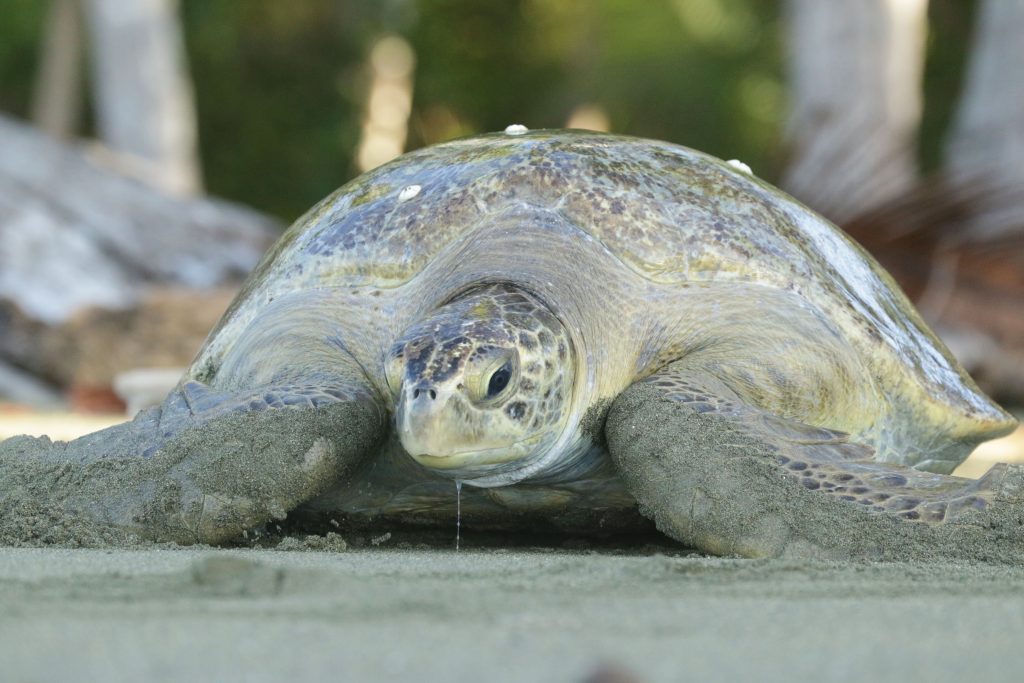
Notes: The Green Sea Turtle (Chelonia mydas) is one of the largest and most widely distributed marine turtles in the world. It does not get its common name from the color of its shell, but rather from the greenish color of its subdermal fat, which is stained by its strictly vegetarian adult diet.
Anatomy and shell structure for identification:
-
Carapace (Upper Shell): Broad, smooth, and heart-shaped (depressed and oval in adults). Unlike the Hawksbill turtle, the bony plates (scutes) on a Green turtle’s shell do not overlap; they sit flush side-by-side. The carapace features four pairs of lateral scutes.
-
Plastron (Lower Shell): Visually distinct from the dark upper shell, the plastron ranges from a pale yellow to a creamy white color.
-
Head Pholidosis (Scaling): A definitive field marker for identifying a Green turtle is its face. It possesses only a single pair of prefrontal scales between the eyes (other sea turtles typically have two pairs) and a short, serrated, un-hooked beak designed for cropping vegetation.